
The Night Dogs Bay at the Terminal
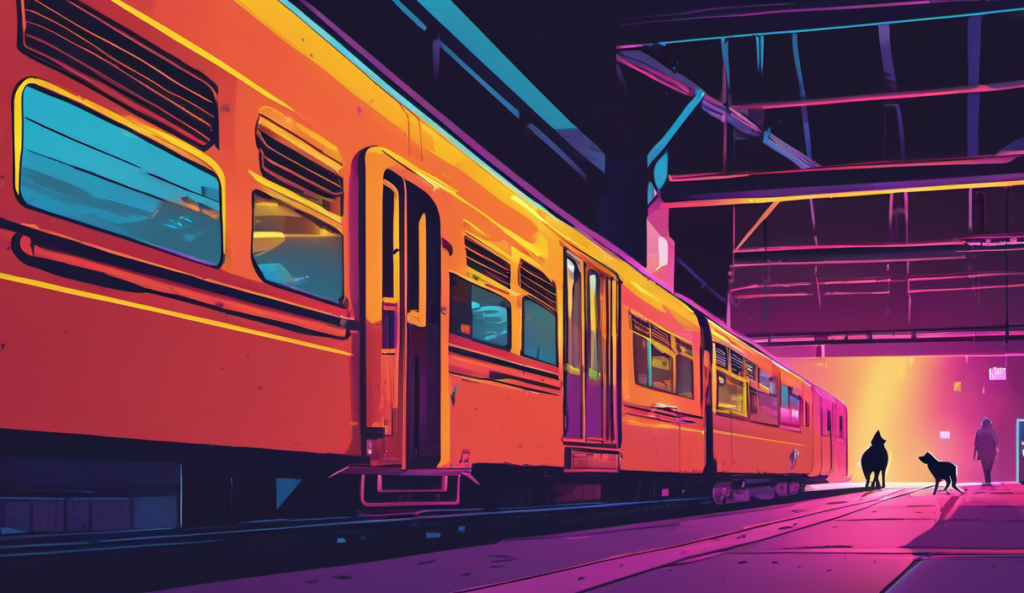
When had the last train pulled into the terminal? Years ago now—he could no longer say how many. He had kept watch over the maintenance shed by the tracks even after the line was abandoned, and his work had dwindled to two things: waiting for trains that never came, and feeding the stray dogs.
The faded movie poster still hung on the waiting room wall. Twenty years of sunlight had bleached the lead actress’s smile into a white blur; no one could say whose face it had once been. What is lost always loses its shape. And yet, shapeless, it goes on hanging there. That, he thought, is what the world is like.
Back when he worked at a securities firm, the numbers were always right. The S&P 500 was the world’s faith itself. So long as faith held, the numbers kept rising. So long as they rose, faith was preserved. He had been seduced by the beauty of that cycle, and at the same time felt something like nausea at the thinness of the premise that it could never break. Everyone knew. Everyone knew, and no one said a word. Those who spoke lost their seats.
At a fixed hour each day, the strays gathered at the broken end of the tracks. They were dogs that had been driven out of town, but lately they sat in a strange order. The largest dog took the front, and behind it the others arranged themselves as if by age—a tidy formation such as no pack of dogs should have.
He spent months observing them before it struck him: their arrangement resembled a market chart. When the lead dog’s position rose, the market rose. When it sank, the market fell. The dogs were receiving some kind of signal. A frequency? A tremor in the earth? Or the heartbeat of the city, inaudible to humans?
Strangely, watching the dogs move, he found himself thinking of a women’s soccer match in a faraway country, seen on television years ago. Eleven players running as one body, no one hesitating, no one standing out, carrying the ball with a single will. It had been beautiful. But he had not noticed, then, what lay behind that beauty: the individual, left behind. Perhaps that is what a pack is. Humans and dogs alike know well how to lose the self.
The discovery was useless. Or perhaps too useful. This was while he was still at the firm; he had shown his supervisor a photograph of the dogs. The supervisor laughed. If dogs can predict the market, he said, let them be the investors. Six months later, the supervisor liquidated the fund and moved to a villa overlooking the sea. The dogs had been right. Only the humans pretended not to know.
Today, too, the dogs assembled. But today their usual order had collapsed. The lead dog did not sit. It stood facing down the tracks, toward the city, and did not stir.
He stood on the platform of the abandoned station, buffeted by the dry wind. The lights were long gone. In the dusk the rails stretched into the distance like bands of black light, dissolving where they ended. This was supposed to be the last station, yet the tracks seemed to continue beyond. It was an illusion—only the unremoved remains of the line, reaching into the dark. And still, he could not shake the feeling that the world, having been told this was the end, was quietly making its way toward somewhere else.
One dog barked. Then two, then three. The cries overlapped and soon settled into a rhythm, a sound with a regular beat. Like the signal announcing the order of fireworks waiting to be launched. Or like horses in a faraway country, pawing the ground inside the gates of a racetrack.
He opened his smartphone. The index was still climbing. Everything was fine. Finer than fine. The dogs’ throats went on trembling. They were answering a sound only dogs could hear. Humans heard nothing. Humans heard nothing at all.
He scattered the feed. The dogs began to eat, slowly, their broken formation still in place. Only the lead dog did not eat. It remained standing, watching the city.
Tomorrow the market would open. The world was meant to grow. It had to keep growing. If it stopped growing, faith could not be maintained. But he knew. The reason the dogs gathered at the last station was not that it was safe. It was because this place stood closest to the end. This was where those who wished to know the end before anyone else came to listen. That was the station’s new role.
Once before, he had sensed that something lay behind the numbers, and had done nothing. This time, he told himself. This time, he would do something. But what he should do, he did not know. If he rang the alarm, he would be laughed at, just as he had been twenty years ago. If he kept silent, he could remain, at most, a man who scattered feed.
The night deepened. The barking did not stop. Did the sound reach the high-rise windows of the distant city? Did it find someone’s ear—would someone open a window and listen to the wind? Or were all the windows sealed shut behind double panes? The barking crossed the night and quietly dissolved into the hum of machines routing orders into tomorrow’s market.