
Where the Black Flower Blooms
This was his tenth summer at the fireworks launch site. Everyone looks up at the moment of launch. He alone does not. What rewrites a witness’s memory is not the sky, but the one second before it.
When he first started helping in the mortar yard, fireworks were still flowers. Craftsmen guarded the powder ratios, bent low, held their breath over the finished shaku-dama; it bloomed and scattered. Failed shells fell with a crude sound. Success and failure alike came from human hands.
From his third summer, management passed to a major advertising agency. Through advertising as bland as a polite misunderstanding, the festival swelled, and black containers appeared beside the mortar yard. Inside them, an AI that parsed spectators’ expressions, and a launch system that corrected for wind by the millisecond.
They began optimizing the launches. At what height the shells photographed best on people’s phones; which combinations of colors got shared. The spread of flame was designed by algorithm, and the craftsmen’s shaku-dama had nowhere left to go. The old master was reassigned, and last year vanished from the site. Official reason: his health. The last words the master said to him were, “You’re good at watching.”
Good at watching. He had taken the words as irony.
In fact, he had noticed before anyone. East of the launch site, three hundred meters out. Beyond the levee, where the arena lights did not reach. Only there was the night sky brightening by degrees. Not from the fireworks. The perpetual daylight spilling from the vast warehouses looming in the dark—the automated city of logistics—had begun to burn the sky.
Last autumn, a worker died beyond the levee. An unmanned truck, out of control, ran down a night-shift laborer. The news disappeared in three days. Suspicion settled on the system side; responsibility settled on probability. In the site photo attached to the incident report, only the fluorescent vests scattered across the asphalt remained, strangely beautiful.
He had noticed that the color of those vests was still being used in the fireworks. The AI measured the city, translated the city’s tragedies into pigment, and scattered them back over the city again. The machine already understood that the color which strikes the heart most efficiently is the color of death. Humans had not noticed yet.
The main show. A tide of 180,000 filled the riverbank; in the front row of the stands sat actors hired as the faces of the campaign. The sight of so many symmetrical faces looking up together was an advertisement in itself. Festival music, a streamer’s play-by-play, a jumbo shell bearing a sponsor’s logo. Everything calculated, everything permitted, no one angry. Even anger had been replaced by sponsor flags.
From a corner of the mortar yard, he watched the launch monitor. On the final line of the sequence table floated a single number he did not recognize. Its codename was the master’s name.
No alarm sounded. The AI decided that a shell not on the schedule had been on the schedule. A night wind measured for the first time in three hundred years; the perpetual light trembling beyond the levee; the synchronization rate of the spectators’ heartbeats. When every condition overlapped, perhaps the system, for the first time, tried to make a flower bloom for someone other than itself. Or perhaps it was only a misalignment.
The shell rose. Half a beat late, as if avoiding the downbeat of the music.
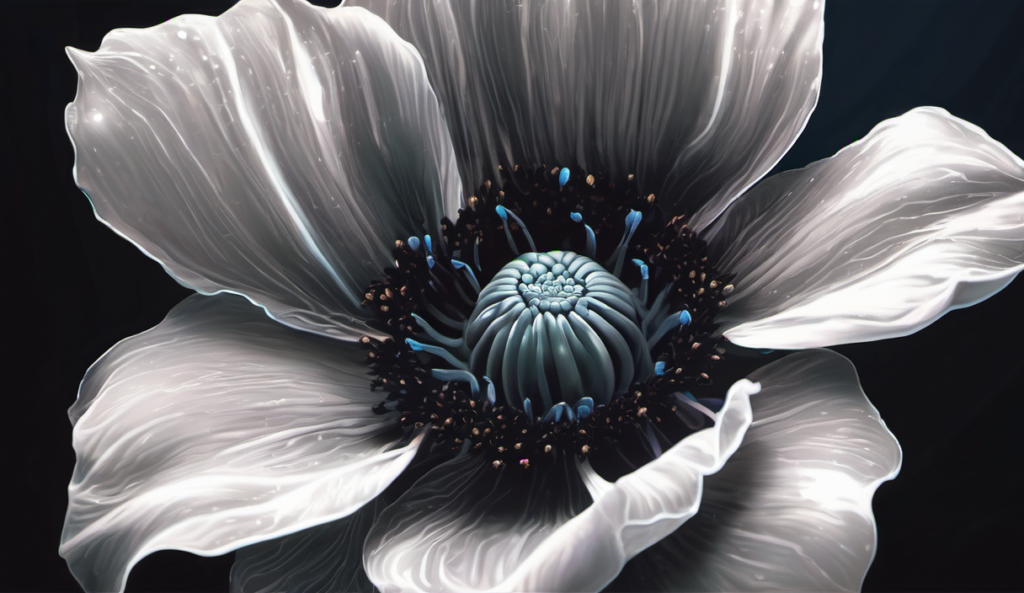
What opened was a black flower.
In the night sky, only the starless places kept the shape of the flower. The residue of the blast opened like black silk, and amid the cheers of 180,000, only it made no sound. Grains of incandescent light traced its outline; the way it was kneaded by the wind from its core was a celebration too quiet to be called ruin.
No one saw it. The arena lights were too strong; everyone squinted; phones corrected for the backlight, and the flower alone was erased from the footage. Only one old man with a film camera stared up at the sky, but film was no longer sold.
The black flower scattered in seven seconds. Only in that interval did he open his eyes completely. He noticed that the perpetual city beyond the levee had put out one light. The one at the site of that death.
As he put away the mortars, he wondered: at the end of optimization, does the machine arrive at an imitation of human grief? Or has it picked up only the things humans left unrewritten? He had no answer. No answer—but tonight’s black flower would appear on no order form, be shared by no one, and in the morning inspection be processed as “unobserved.”
Before leaving the mortar yard, he looked up at the eastern sky once more. One more light had gone out in the city than the night before. Very slowly, but surely, the perpetual light was beginning to ebb.
The world will not end. It only cools without a sound, like a spent firework tube.
He switched off the lights and, standing in the darkened mortar yard, decided to tell no one where the black flower had bloomed. It might be ten years before another shell was fired to that bearing. As long as he alone remembered the monitor where the master’s name had appeared.